
Electromagnetism

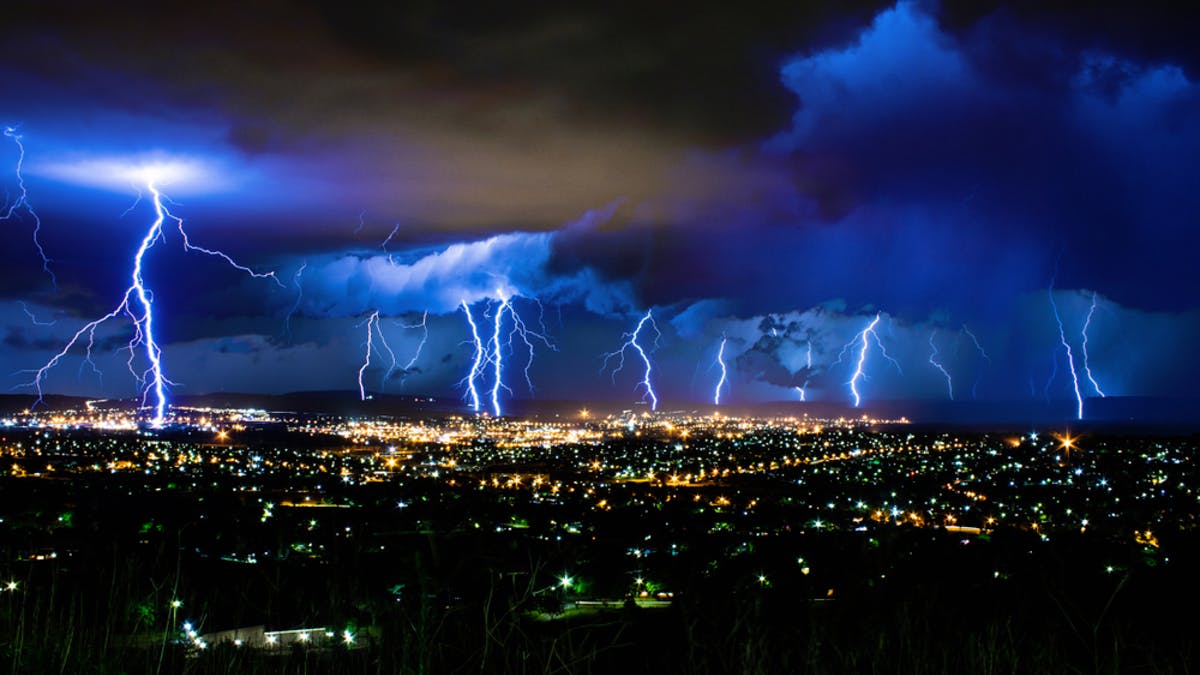
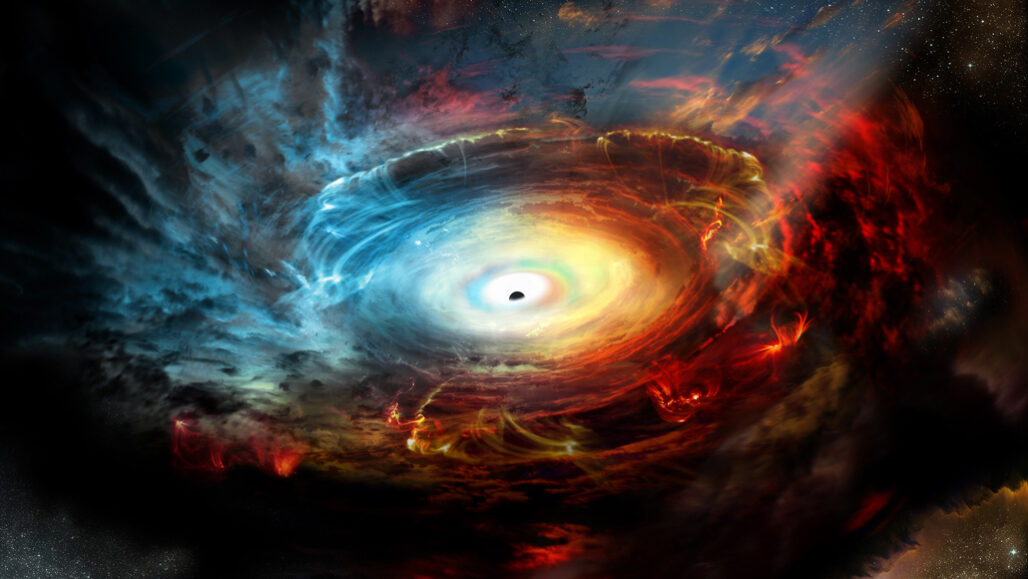
Electromagnetism is one of the four fundamental forces (or interactions) of nature, which include the strong interaction, the weak interaction, and gravitation. It seems to be a combination of two fields—the electric field and the magnetic field.

We understand surprisingly little about electromagnetic energy, despite the fact that we are utterly reliant on it for everything from the electrical impulses in our brain and nervous system to global wireless communications. It warms the Earth, creates what we call light and colors, and produces rainbows and the Northern Lights.
Read more »

Electromagnetism

Electromagnetism is one of the four fundamental forces (or interactions) of nature, which include the strong interaction, the weak interaction, and gravitation. It seems to be a combination of two fields—the electric field and the magnetic field.

We understand surprisingly little about electromagnetic energy, despite the fact that we are utterly reliant on it for everything from the electrical impulses in our brain and nervous system to global wireless communications. It warms the Earth, creates what we call light and colors, and produces rainbows and the Northern Lights.

Read more »

Discoverers of Electromagnetic Energy

Michael Faraday

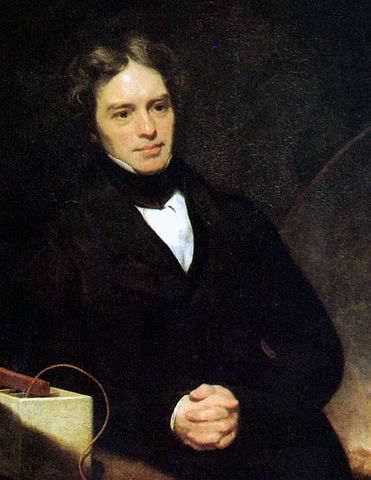
Michael Faraday was one of the most famous scientists in history, and is known as the ‘Father of Electricity’. He was born September 22, 1791 in London, England, UK and died August 25 in 1867 at the age of 75. His father was a blacksmith. Before they married, his mother had worked as a servant. England was a tough place for the poor, and they lived in great poverty.

Sir Humphrey Davy was one of Michael Faraday’s heroes. When Davy had an unfortunate accident in his lab, he asked Michael to work for him by writing his lab notes. This was a dream come true for Faraday. Davy soom saw the boy’s potential, and made him chemical assistant at the Royal Institute. As the years went by, Faraday was promoted, and eventually became a full professor.

Read more »

What Is Sound?

  1. Vibrations cause waves in a medium, and sound is transported by the vibrations.
  2. Sound requires a source, a medium and a receiver.
  3. A wave can be thought of as energy traveling through a medium.
  4. Sound waves are compression waves or longitudinal waves, which are made of vibrating particles that bump into other particles, causing those particles to vibrate and bump into more particles, and so on.
  5. We hear sounds because vibrations in the air cause our ear drums to vibrate.
  6. Amplitude is a measure of height of the wave on a graph from the middle to its highest point.
  7. Frequency is the time that passes between two wave peaks. The frequency of a wave refers to the number of cycles per second.
  8. Frequency is easily confused with speed. A wave can vibrate very frequently, yet travel at a small speed through a medium, or a wave can vibrate with a low frequency, yet travel at a high speed through a medium.
  9. The speed of an object refers to how fast it moves in a set amount of time, such as 5 miles/hour. The speed of a wave is the distance a given point on the wave (such as the crest) travels through a medium in a set amount of time.
  10. Hertz (Hz) is mathematical unit for frequency where 1 Hz = 1 cycle per second.
  11. Sound travels a different speeds in different conditions. We usually think of the speed of sound in air. However, the speed of sound varies from substance to substance. Typically sound travels most slowly in gases, faster in liquids, and faster still in solids.
  12. Sound travels at 343 m/s in air in ideal conditions, it travels at 1,481 m/s in water (almost 4.3 times faster) and at 5,120 m/s in iron (almost 15 times faster). In an exceptionally stiff material such as diamond, sound travels at 12,000 metres per second (39,000 ft/s),—about 35 times its speed in air and about the fastest it can travel under normal conditions.
  13. Reflection phenomena (or echos) are commonly heard with sound waves. We can use echos to measure distance, for example in auto-focusing cameras.

Vibrations and Waves

Sound is all about vibrations. To make a sound, there needs to be a source—something that vibrates—whether it’s a musical instrument, the larynx (voice box) of a person, or the movement of Tectonic Plates. But there’s more to it than that.

Read more »

Glass Harp

  1. Friction between our fingers and the glass causes the glass to vibrate.
  2. The vibrating glass causes the air to vibrate, which our ears interpret as sound.
  3. Different glasses vibrate at different frequencies, which our ears interpret as tones.
  4. When water is added to the glass, it can alter the frequency of the vibration, which changes the tone.
  5. As the water vibrates, we can see the compression waves on the surface of the water.
  6. Glass, which is a very rigid substance, can shatter if the compression waves become too strong.
  7. We interpret random sound as noise. We experience certain sounds as beautiful and harmonious, and we create music with them.
  8. Some people seem to have a gift for sensing sound. They may have perfect pitch, and have the ability to imagine and spontaneously create complex musical arrangements. Mozart and Beethoven are well-known examples of a musical geniuses.

Materials

  1. One or more wine glasses, drinking glasses, etc.
  2. A little bit of vinegar
  3. Tap water
  4. Dishwashing detergent

Directions

  1. Wash off the natural oils on your fingers with dishwashing detergent.
  2. Moisten your fingers with a little vinegar, and rub them on the rim of a wine glass until it rings.
  3. Fill a wine glass about $ \frac{3}{4} $ full of water, and make it ring again.
  4. Observe the vibrations at the surface of the water as the glass vibrates.

Variations

  1. Try different sized glasses, with different amounts of water in them.
  2. Try tuning several glasses and playing a song.

Boy Breaks Wine Glass with Voice (1:34)

Don’t try this at home!

Read more »

Speed of Light

  1. What is light?
  2. What is the dual wave-particle nature of light?
  3. What is the dual magnetic-electric nature of light?
  4. What is the speed of light?
  5. Why is the speed of light?
  6. How does light travel?
  7. What is the electromagnetic spectrum?
Term Description
FPS Frames per second
Particle A unit of matter
Photon An elementary particle of light
Speed of Light 186,000 mi/s
Wave An oscillation through space

The Speed of Light

Electromagnetic energy waves travel at what we call the Speed of Light. Why light travels at exactly this speed is not known. This is one of the deepest mysteries of physics.

Read more »

Light Refraction

Bending Light

Rainbows

Read more »

Lighting

Lightning

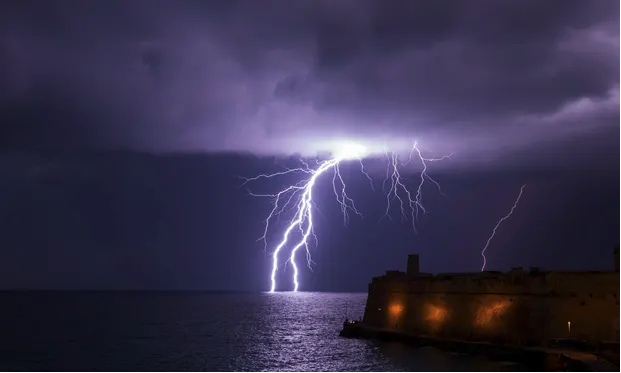
Lightning is an electrical discharge caused by imbalances within clouds, or between storm clouds and the ground.

It is not only spectacular, it’s dangerous. Over 2,000 people are killed worldwide by lightning each year. Hundreds more survive strikes but suffer lasting symptoms, including memory loss, dizziness, weakness, numbness, and other life-altering ailments. Strikes can cause cardiac arrest and severe burns, but nine of every ten people who are struck survive.

Read more »

Microwaves

What is Microwave Radiation?

Microwaves are a form of electromagnetic radiation; that is, they are waves of electromagnetic energy moving through space.

Electromagnetic radiation spans a broad spectrum from very long radio waves to very short gamma rays. The human eye can only detect a small portion of this spectrum called visible light. A radio detects a different portion of the spectrum, and an X-ray machine uses yet another portion. Visible light, microwaves, and radio frequency (RF) radiation are forms of non-ionizing radiation. Non-ionizing radiation does not have enough energy to knock electrons out of atoms.

Read more »

Sound Propagation

Sound is all about vibrations. To make a sound, there needs to be a source—something that vibrates—whether it’s a musical instrument, the larynx (voice box) of a person, or the movement of Tectonic Plates…

Read more »