
Propagation of Sound G6

Main Ideas

  1. Vibrations cause waves of vibrations in a medium, and sound is transported by these vibrations.
  2. Sound requires a source, a medium and a receiver.
  3. We hear sounds because vibrations in the air cause our ear drums to vibrate.
  4. Resonance occurs when a object vibrates in harmony with a sound wave.
  5. Sound travels at about 343 m/s in air.
  6. Sound travels at different speeds in different mediums and conditions.
  7. Reflection phenomena (echos) are commonly heard with sound waves. We can use echos to measure distance, for example in auto-focusing cameras.

Vocabulary

  • Vibration
  • Sound Wave
  • Pitch (Frequency)
  • Volume (Amplitude)
  • Frequency (Tone)
  • Timbre (Qualities of sound)
  • Resonance
  • Echo (Reflection Phenomena)
  • Speed of Sound

What is Sound?

A sound is a form of energy, similar to electricity, heat or light. Sound waves are the result of the vibration of objects. These vibrations propagate as acoustic waves through a medium such as a gas, liquid or solid.

Read more »

Sources of Sound G6

Vocabulary

  • Echo (Reflection Phenomena)
  • Amplitude (Volume)
  • Pitch
  • Percussion
  • Friction
  • Vibration
  • Resonance
  • Tone
  • Notes (Musical Notation)
  • Sound Qualities
  • Noise
  • Music
  • Intervals
  • Beat and Rhythm
  • Speed of Sound

Sources of Sound

  1. Wind (air)
  2. String (plucking, strumming, bowing)
  3. Percussion (includes pianos!)
  4. Friction (scratching a chalkboard, etc.)
  5. Electronic (a variety of sources from vibrating crystals to electromechanical devices)

Qualities of Sound

Some sounds are high and others low; some are loud and others barely audible; some are pleasant and others harsh.

Read more »

Electromagnetism

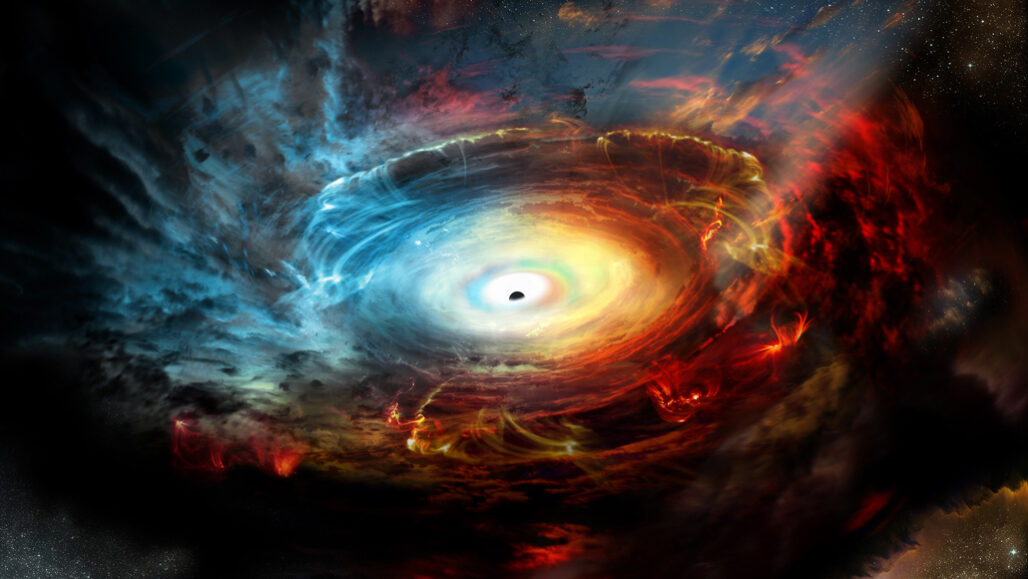
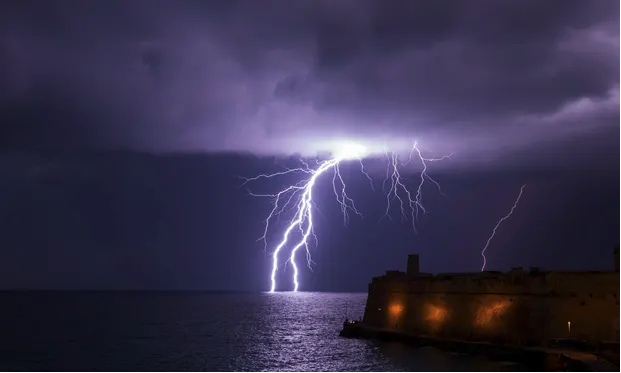
The electromagnetic force is a mysterious field that is essential to everything we know. It seems to be composed of two fields—the electric field and the magnetic field.

We understand surprisingly little about electromagnetic energy, despite the fact that we are utterly reliant on it for everything from the electrical impulses in our brain and nervous system to global wireless communication systems. It holds all matter together. It causes all chemical reactions, and it creates the visible radiation that we call light and color.

Read more »

Sources of Heat

Vocabulary

  • Friction
  • Stress
  • Combustion
  • Radiation
  • Entropy
  • Fire
  • Convection
  • Conduction

Sources of Heat

  1. Friction (Mechanical)
  2. Stress (Mechanical)
  3. Combustion (Chemical “fire”)
  4. Radiation (Electromagnetic)
  5. Entropy (Heat loss)

Propagation of Heat

  1. Radiation
  2. Convection (Liquid or gas materials move, such as in a lava lamp)
  3. Conduction (Heat is transferred within material, but material does not move.)

Demonstrations

  1. Friction: Rubbing hands
  2. Friction: Starting fire by rubbing sticks
  3. Friction: Matches
  4. Stress: Bending paperclips and other metal objects
  5. Combustion: Candle and gas torch
  6. Radiation: Incandescent lamp
  7. Radiation: White and black paper on a hot day
  8. Radiation: Heat of metal door in morning and afternoon

Read more »

Visible Light

Vocabulary

  1. Darkness
  2. Light
  3. Visible Light
  4. Refraction
  5. Dispersion
  6. Angle of Refraction
  7. Incidence of Refraction
  8. Prism
  9. Rainbow
  10. Laser

Light

Light is a form of invisible energy. Light energy can travel through transparent objects, and even through a vacuum such as outer space.

Our eyes can see visible light, but we can only see light at its source, and when it bounces off of an object. The sky looks blue to us during the day because light energy from the sun is bouncing off of dust and vapor in the atmosphere. If there were no atmosphere, the sky would look black.

Read more »

Sound in Water

  1. Sound travels at different speeds in different media.
  2. The more solid the medium, the faster the sound travels.
  3. Sound travels faster in water than in air.
  4. Sound has a higher amplitude (is louder) in water than in air.

Bathtub Experiment

Materials
  1. One bathtub with working hot and cold water faucets and a drain that can be closed.
  2. One live experimenter’s head fully equipped with working ears.
  3. One good human knuckly for lightly tapping the side of the bathtub.
  4. One (or more) dry towels.
  5. A variety of other tapping objects, such as pencils, erasers, spoons, piece of wood, piece of metal, etc.
Directions
  1. Lightly tap the side of your bathtub.
  2. Fill the bathtub with water. (Choose a comfortable temperature!)
  3. Take a good breath and dunk your head under water being sure that both ears are under the surface.
  4. Lightly tap the side of the bathtub in exactly the same way as you did before.
  5. Note the differences in volume, pitch, tone, etc.
Experiment…
  1. How does the effect change when only one ear is under water?
  2. How does tapping the tub with different kinds of objects change the nature of sound under water?
  3. How does it sound when you tap the side of the bathtub that is underwater (inside the tub).
  4. While your head is underwater, can you hear far away sounds, perhaps in other parts of the house through the water that you can’t hear in the air?
  5. While your head is underwater, can you hear sounds inside your body that you can not hear in the air, such as the beating of blood in your ears?
  6. Would the effect change if the temperature of the water was much hotter or colder?
  7. What other questions can you explore?
  1. You can use the Main Ideas above as a starting point for writing your own conclusions.

Read more »

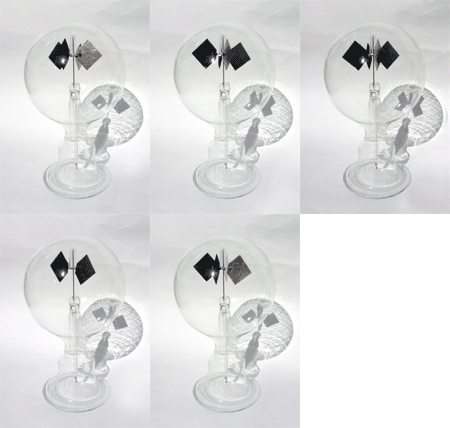
Radiometer

Vocabulary

Ye Basic Radiometer

Ye Basic Radiometer

  1. Light Energy
  2. Light Ray
  3. Solar energy
  4. Thermal energy
  5. Kinetic energy
  6. Absorption
  7. Molecule
  8. Atmosphere
  9. Radiation

Materials

  1. Radiometer
  2. Sunlight
  3. Objects to create shadows

Procedures

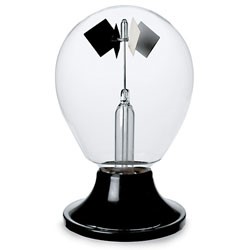
  1. We placed the Radiometer in darkness and observed that it did not spin.
  2. Then we placed the Radiometer in full sunlight and observed that it rotated rapidly.
  3. While the Radiometer is in full sunlight, we created shadows to block light rays from reaching the Radiometer, and observe that it stopped spinning.
  4. Then we removed the shadows letting the sunlight hit the Radiometer again, and observed it spin rapidly.

Explanation

Heat energy moves from hot objects to cold objects by conduction, convection and radiation. Of these three, only radiation does not require actual contact. For example, the sun warms the Earth because its heat radiation travels through empty space. Any warm object, such as the sun, a toaster or the human body, gives off thermal energy, called infrared radiation, or I.R.

Read more »

Expansion and Contraction

Vocabulary

  • Expansion
  • Contraction

Heat Expansion and Contraction

Heat causes materials to expand. Some common examples of heat expansion are the boiling water in steam engines, volcanic eruptions, hot air balloons, and hot metal objects.

As objects cool down again the contract (shrink). The gradual expansion and contraction of rock under the heat of the sun is one reason why even the mightiest mountains slowly crack and crumble.

Ancient mountain gradually cracking under the forces of repeated heating and cooling.

Demonstrations

  1. Metal ball and ring (bowl of water)
  2. Bi-metalic objects
  3. Heating air below a toy parachute
  4. Fish weight on metal cable

Read more »

Visible Light

Vocabulary

  1. Visible Light
  2. Dispersion
  3. Refraction
  4. Angle of Refraction
  5. Incidence of Refraction
  6. Prism
  7. Rainbow
Double Rainbow

Refraction and Dispersion

Dispersion is the spreading of white light into its full spectrum of wavelengths (or colors).

Refraction causes dispersion of light in rainbows, prisms, and many other situations.

The angle of refraction (or index of refraction) depends on the specific wavelength (or color) and the kind of medium (the material the light energy is passing through).

Read more »

Speed of Light

  1. What is light?
  2. What is the dual wave-particle nature of light?
  3. What is the dual magnetic-electric nature of light?
  4. What is the speed of light?
  5. Why is the speed of light?
  6. How does light travel?
  7. What is the electromagnetic spectrum?
Term Description
FPS Frames per second
Particle A unit of matter
Photon An elementary particle of light
Speed of Light 186,000 mi/s
Wave An oscillation through space

The Speed of Light

Electromagnetic energy waves travel at what we call the Speed of Light. Why light travels at exactly this speed is not known. This is one of the deepest mysteries of physics.

Read more »