
Electromagnetism

Electromagnetism is one of the four fundamental forces (or interactions) of nature, which include the strong interaction, the weak interaction, and gravitation. It seems to be a combination of two fields—the electric field and the magnetic field.

We understand surprisingly little about electromagnetic energy, despite the fact that we are utterly reliant on it for everything from the electrical impulses in our brain and nervous system to global wireless communications. It warms the Earth, creates what we call light and colors, and produces rainbows and the Northern Lights.
Read more »

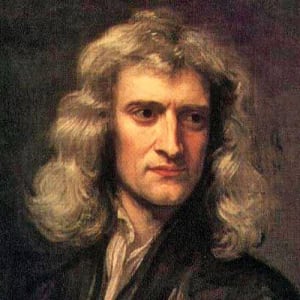
Isaac Newton

Isaac Newton (1643 - 1727 CE)

Sometimes called the father of modern science, Isaac Newton revolutionized our understanding of the world. He was a Renaissance Man with major accomplishments in many fields, including astronomy, optics, physics and mathematics. Newton gave the world revolutionary new theories on gravity, planetary motion and optics.

With the publication of Philosophiae Naturalis Principia Mathematica in 1687, Newton laid the groundwork for modern physics. The publication become known as the “first great unification”, as it unified our understanding of gravity on Earth with the behavior of planets, solar systems, and stars. This publication cemented Newton’s position as one of the leading scientists of all time

Read more »

Laws of Motion

Isaac Newton

In science, “laws” are observations about the physical universe that seem to be true for all things in all places. They are believed to be som of our bst explanations for what really is reality. In the 1600s in England, Sir Isaac Newton discovered several of these laws, the laws for gravity, motion, the motion of the planets, light, and color. He discovered so many things and could show so clearly how they worked using experiments and m

Read more »

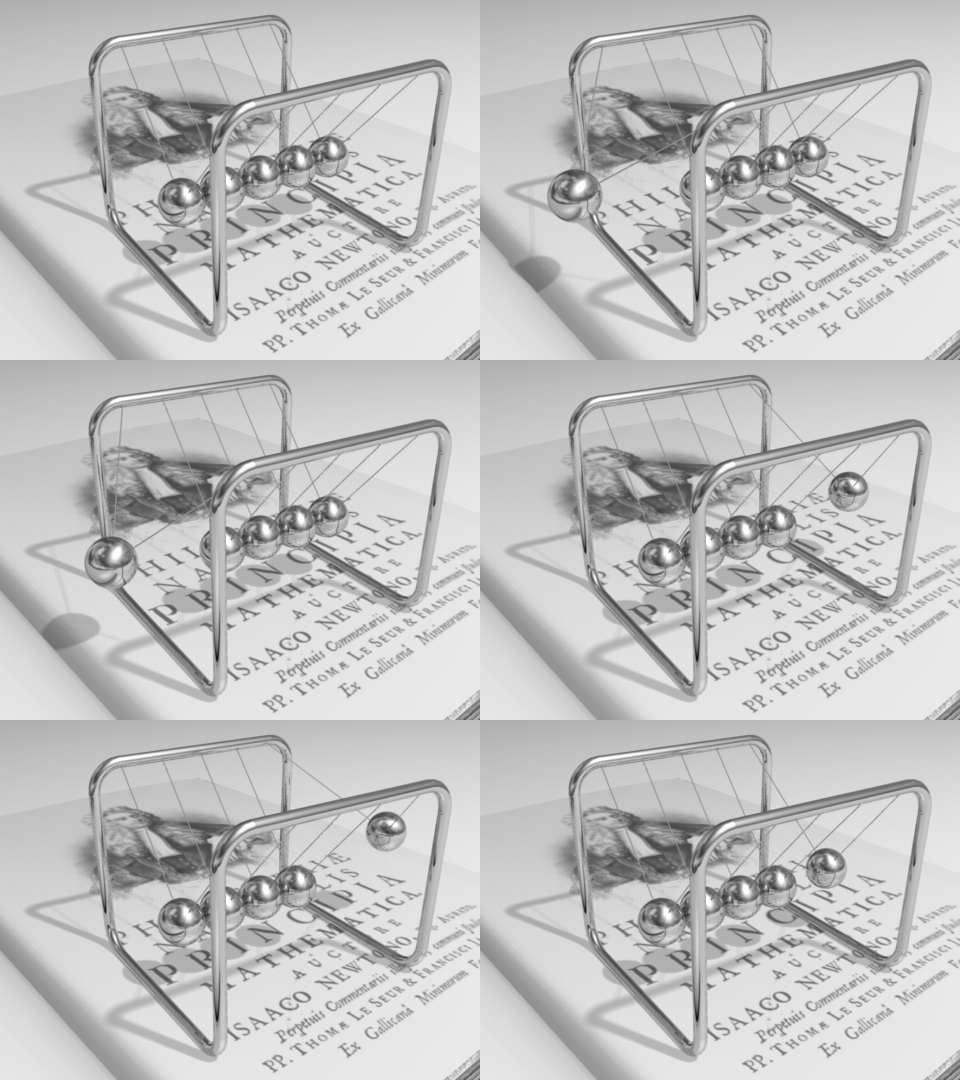
Newton's Cradle

A Newton’s Cradle demonstrates the conservation of momentum and the conservation of energy using swinging spheres.

When we swing a marble on the end of the cradle, it collides with the marble next to it, and the force of that collision travels through each of the other marbles until it reaches the last one, which suddenly swings upward due to the force transferred to it. When the marble swings back due to the pull of gravity, the force of momentum travels back through each marble again, repeating the process.

Read more »

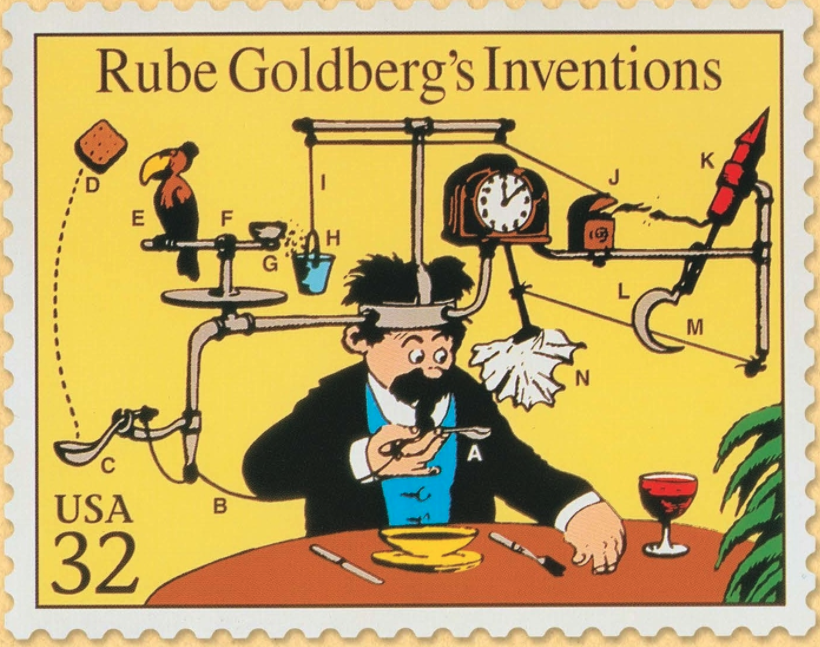
Rube Goldberg Cartoons

Directions

  1. Create a first draft of an original Rube Goldberg cartoon. Take the time to do a good drawing. Effort and quality are important.
  2. Draw the cartoon the way Rube Goldberg did, with outlined panels. One panel should describe the steps of the machine. The other should illustrate the machine, with each step labeled, A, B, C, D, etc. See examples below.
  3. The machine must include at least four steps. Use a variety of simple machines.
  4. See Study Guide — Six Simple Machines.

Rube Goldberg

Rube Goldberg was an American Pulitzer Prize winning cartoonist, sculptor, author, engineer, and inventor, and his work is a classic example of the melding of art and science. He began his career as an engineer, but soon focused on cartooning.

Read more »

The Four Fundamental Forces of the Universe

Einstein

  • Full name: Hans Albert Einstein.
  • Born: 14 March 1879, in Ulm, Germany
  • Died: 18 April 1955, in Princeton, US
  • Very imaginative and dreamy as a child.
  • Was considered a poor and disobedient student in school because he asked too many questions.
  • Loved learning math.
  • Studied in Milan, Italy, where his curiosity and questions were welcome.
  • Wrote several scientific papers at an early age, but they were ignored due to his youth.
  • In 1905, a year sometimes described as his annus mirabilis (‘miracle year’), Einstein published four groundbreaking papers.
  • Moved to Switzerland, where he was very happy and met his first wife.
  • Always enjoyed spending time alone, hiking in the woods, and thinking.
  • Enjoyed playing the violin.
  • Had an odd appearance because he did not care what others thought of appearances. Did not comb his hair; often forgot his keys; often forgot to eat.
  • Move to Germany where he met his second wife, Ilse.
  • Developed the Theory of Relativity, $E = mc^2$, which unified our understanding of energy, matter and light.
  • Moved to the US due to threats on his life by the Nazis.
  • Helped develop the atomic bomb because although he opposed militarism, he felt it would be even worse if the Nazis developed it first.
  • Supported the creation of Israel as a homeland for Jews, but came to oppose Zionism due to the treatment of Palestinians.
  • Was happily married for many years to Ilse, and until her death.
  • In later years, lived quietly alone in Princeton, and continued to play his violin.
  • Died quietly while working on an equation.

The Four Fundamental Forces

The familiar force of gravity pulls you down into your seat, toward the Earth’s center. You feel it as your weight. Why don’t you fall through your seat? Another force, electromagnetism, holds the atoms of your seat together, preventing your atoms from intruding on those of your seat.

Read more »

The Pendulum

Potential Energy

Potential energy is an important form of energy in physics. Potential energy is stored energy that can be converted back into kinetic energy at a later time. Examples of potential energy include: gravitational (such as a pendulum at the top of it’s swing), electrical (such as a charged capacitor), magnetic (such as induction in an electric current) and nuclear (such as the strong force holding the nuclei of atoms together).

Read more »

The Scientific Method

The scientific method is critical to the development of scientific theories. These theories are then used to try to explain the empirical (experiential, observable, measurable) world.

Read more »

Discoverers of Electromagnetic Energy

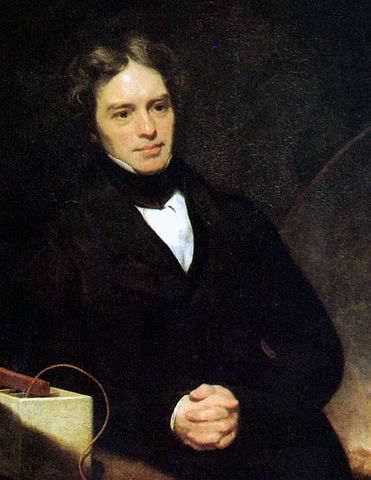
Michael Faraday

Michael Faraday was one of the most famous scientists in history, and is known as the ‘Father of Electricity’. He was born September 22, 1791 in London, England, UK and died August 25 in 1867 at the age of 75. His father was a blacksmith. Before they married, his mother had worked as a servant. England was a tough place for the poor, and they lived in great poverty.

Sir Humphrey Davy was one of Michael Faraday’s heroes. When Davy had an unfortunate accident in his lab, he asked Michael to work for him by writing his lab notes. This was a dream come true for Faraday. Davy soom saw the boy’s potential, and made him chemical assistant at the Royal Institute. As the years went by, Faraday was promoted, and eventually became a full professor.

Read more »

What Is Sound?

  1. Vibrations cause waves in a medium, and sound is transported by the vibrations.
  2. Sound requires a source, a medium and a receiver.
  3. A wave can be thought of as energy traveling through a medium.
  4. Sound waves are compression waves or longitudinal waves, which are made of vibrating particles that bump into other particles, causing those particles to vibrate and bump into more particles, and so on.
  5. We hear sounds because vibrations in the air cause our ear drums to vibrate.
  6. Amplitude is a measure of height of the wave on a graph from the middle to its highest point.
  7. Frequency is the time that passes between two wave peaks. The frequency of a wave refers to the number of cycles per second.
  8. Frequency is easily confused with speed. A wave can vibrate very frequently, yet travel at a small speed through a medium, or a wave can vibrate with a low frequency, yet travel at a high speed through a medium.
  9. The speed of an object refers to how fast it moves in a set amount of time, such as 5 miles/hour. The speed of a wave is the distance a given point on the wave (such as the crest) travels through a medium in a set amount of time.
  10. Hertz (Hz) is mathematical unit for frequency where 1 Hz = 1 cycle per second.
  11. Sound travels a different speeds in different conditions. We usually think of the speed of sound in air. However, the speed of sound varies from substance to substance. Typically sound travels most slowly in gases, faster in liquids, and faster still in solids.
  12. Sound travels at 343 m/s in air in ideal conditions, it travels at 1,481 m/s in water (almost 4.3 times faster) and at 5,120 m/s in iron (almost 15 times faster). In an exceptionally stiff material such as diamond, sound travels at 12,000 metres per second (39,000 ft/s),—about 35 times its speed in air and about the fastest it can travel under normal conditions.
  13. Reflection phenomena (or echos) are commonly heard with sound waves. We can use echos to measure distance, for example in auto-focusing cameras.

Vibrations and Waves

Sound is all about vibrations. To make a sound, there needs to be a source—something that vibrates—whether it’s a musical instrument, the larynx (voice box) of a person, or the movement of Tectonic Plates. But there’s more to it than that.

Read more »